
Thai stock market growth: The power of AI and a new role on the Southeast Asian investment stage
Foreword
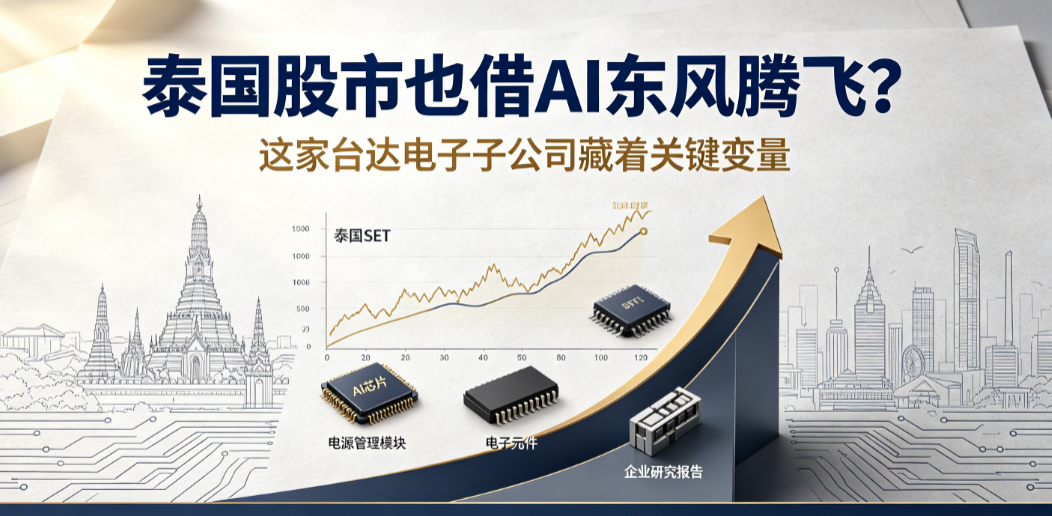
This year, the Thai stock market became the star of Southeast Asia, with the SET index rising nearly 23% since the beginning of the year. This is a very notable phenomenon, as many global markets have been affected by economic uncertainty and international trade. Behind this success, however, is an unexpected factor: the global artificial intelligence (AI) trend, which has opened new opportunities for investors seeking emerging avenues to participate in this wave.
The Thai stock market, once viewed by investors as a market driven by tourism, banking, and domestic consumption, is now transforming into a stage full of innovation and technology, challenging traditional views. This article will deeply analyze the key factors driving the Thai stock market, including the central role of Delta Electronics (Thailand) Public Company Limited in this transformation.
Reshaping the Thai Stock Market with AI Power
The growth of the Thai stock market this year has mainly come from the performance of Delta Electronics (Thailand) Public Company Limited, a subsidiary of Delta Electronics, Taiwan. This company is a manufacturer of energy management systems for AI data centers, thus becoming an important infrastructure supplier supporting the global AI revolution. This year, the stock price of Delta Electronics (Thailand) has risen over 80%, making it the first company in Thailand to reach a market capitalization of 100 billion USD, even larger than the next five largest companies combined.
Role in the MSCI ASEAN Index
In the MSCI ASEAN Index, Delta Electronics (Thailand) is currently the second highest market capitalization company in Southeast Asia, after DBS Bank of Singapore. This reflects a structural change in the Thai stock market, with increasing weight in the eyes of international investors, especially those seeking investment directions in AI-related technology.
Although Thailand does not have top-tier semiconductor companies like Taiwan or South Korea, investors are beginning to realize Thailand's role in providing infrastructure to support AI, opening new doors of opportunity. "Thailand is not a pure AI market, but the country's investments in data centers, electronics, power systems, and digital infrastructure offer new perspectives for investors looking beyond tourism, banking, and domestic consumption," said Ms. Sufianti, a strategist at a well-known economic research institute, in a recent report.
Delta Electronics (Thailand): A Rising Star in Investors' Minds
The growth of Delta Electronics (Thailand) Public Company Limited is the clearest proof of this transformation. The company produces energy management systems for servers and data centers, making it a key infrastructure component supporting AI development.
Mr. Suwas Sinsawat, an analyst at Manati Global Securities, said the company has expanded capacity in time to meet the growing demand from global data centers, with quarterly results consistently exceeding expectations over the past two years, despite the impact of US import tariffs and the Middle East conflict. "This higher-than-expected profitability is expected to continue," Mr. Suwas added.
Weight in the SET Index
Interestingly, Delta Electronics (Thailand) now accounts for one-fifth of the SET index, double that of June 2025. The rapid increase in weight reflects investors' strong confidence in the company's long-term growth potential.
Comparison with Other Asian Markets
Compared with major Asian stock markets such as South Korea and Taiwan, the Thai stock market's reliance on tech stocks is still relatively low. However, Delta Electronics (Thailand) being the only technology company among Thailand's top five market cap companies highlights an important difference.
In South Korea, SK Hynix and Samsung Electronics together account for over half of the KOSPI index weight; in Taiwan, the TAIWAN index is dominated by tech stocks, with TSMC alone accounting for over 40% of the index weight.
In contrast, among Thailand's largest listed companies, Delta Electronics (Thailand) is the only pure technology company in the top ranks, with other companies such as AIS, PTT, Gulf Energy Development, and Airports of Thailand forming the top five.
Other Thai Electronics Companies
While other Thai electronics manufacturing companies have grown this year, they still lag far behind Delta Electronics (Thailand) in scale. Only Cal-Comp Electronics Thailand, KCE Electronics, and Hana Microelectronics have market capitalizations exceeding 10 billion USD.
Summary and Future Trends
The growth of the Thai stock market this year reflects an unprecedented structural change. Delta Electronics (Thailand) becoming a leader in AI infrastructure means the Thai stock market is no longer viewed as solely dependent on tourism and banking.
Investment by the Thai government in digital infrastructure, along with private sector support for AI and cloud technology development, means the Thai stock market is likely to attract more international investor attention in the long term.
However, challenges remain. Over-reliance on a single company, Delta Electronics (Thailand), poses concentration risk, and Thailand's lack of top semiconductor companies means it cannot match markets like Taiwan or South Korea.
Nevertheless, this transformation is a positive sign that the Thai stock market is moving towards a new era of opportunities and business diversification. Investors looking for opportunities in Southeast Asia should pay attention to this change and be prepared to adjust their investment portfolios to align with new trends.
Investor Recommendations:
- Monitor Delta Electronics (Thailand)'s developments, as it affects the overall movement of the SET index.
- Keep an eye on investments in data centers and AI infrastructure, which are key factors driving Thailand's future growth.
- Diversify investment risk to address potential volatility due to heavy reliance on Delta stock.
This transformation not only changes the image of the Thai stock market but also opens new doors of opportunity that all investors should not miss.