
Charging Industry Transformation: Leaping from "Selling Electricity" to "Selling Dispatch"
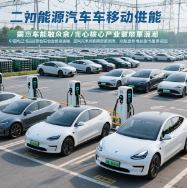
Since July, the national electricity load has repeatedly hit record highs. The "mobile energy storage pool" composed of new energy vehicles has become a key solution to alleviate peak power gaps. Recently, a pilot for reverse electricity sales via vehicle-to-grid (V2G) interaction in private parking spaces was launched in Wuhan. Meanwhile, cities like Hefei and Shenzhen have simultaneously conducted V2G discharge to ensure power supply. The "vehicle-energy integration" scenario, where vehicles and charging piles collaborate in grid dispatch, continues to expand. At the same time, the new energy vehicle charging industry is undergoing a profound transformation — transitioning from a single "selling electricity" model to comprehensive energy services of "selling dispatch". This is both a self-rescue move under profit pressure and an inevitable direction for industry development.
Industry Dilemma: From High Profit to Slim Margin
The latest data from the National Energy Administration shows that as of the end of May 2026, China's total electric vehicle charging infrastructure reached 22.497 million units, up 44.9% year-on-year. However, behind this scale expansion lies an industry-wide profitability dilemma. According to industry insiders, at the beginning of 2024, the charging service fee was 0.2-0.3 yuan/kWh, but by 2025 it had dropped to around 0.17 yuan/kWh. After costs, the profit is only 0.04 yuan/kWh, with losses occurring during off-peak hours.
Yuan Qingmin, Chairman of Lingchong New Energy Technology Co., Ltd., pointed out that around 2018, the charging industry was a high-profit track that could recoup investment in one year. However, after high-quality spots were quickly occupied, homogeneous competition caused service fees to keep falling, while costs such as site rent and equipment depreciation did not decrease accordingly, squeezing operators' profit margins from both ends.
More notably, the industry's revenue structure is extremely single. Previously, charging operators' revenue relied almost entirely on charging price spreads, lacking diversified income to hedge risks. Zhao Yuhui, CEO of Zhejiang Haohan Energy Technology Co., Ltd., said: "Technology is just an entry ticket. The true moat of the charging industry is the ultimate charging experience." When the "selling electricity" business struggles to balance revenue and expenditure, the transformation of the entire industry into comprehensive energy service providers has become inevitable.
Transformation Direction: From "Selling Electricity" to "Selling Dispatch"
Liu Yongdong, Deputy Secretary-General of the China Electricity Council, introduced that by the end of 2025, the number of new energy vehicles in China had climbed to 43.97 million, forming a substantial national "mobile energy storage pool" with massive on-board power batteries. This scale lays the foundation for a new path for charging industry transformation — aggregating charging piles and EVs into adjustable flexible resources to earn revenue by participating in power market services such as grid demand response, peak shaving, and frequency regulation. The industry calls this model "selling dispatch." Operators no longer make money from electricity price differences but from dispatch service fees for helping the grid shave peaks and fill valleys.
The "15th Five-Year Plan for Building a New Energy System" issued by the National Development and Reform Commission and the National Energy Administration in June this year clearly states that EV energy storage resources should be fully utilized to explore vehicle-pile-station-grid integrated interaction, with the goal of reaching about 50 million kW of aggregated adjustable charging capacity through vehicle-grid interaction by 2030. The policy provides clear support for the transformation.
V2G technology offers even more imaginative possibilities for this transformation. While the regulation function of ordinary charging piles is mainly reflected in "reducing charging" and "off-peak shifting," V2G enables EVs not only to adjust charging timing but also to feed power back to the grid, becoming true distributed energy storage units. For example, Hubei Communications Investment New Energy Investment Co., Ltd., relying on 30 ultra-fast charging stations on expressways, aggregates 13.79 MW of adjustable capacity and achieves comprehensive annual revenue exceeding 2 million yuan by participating in power market transactions.
Challenges and Prospects
Despite a clear direction, the transformation still faces three major obstacles. First, the pricing mechanism has not yet formed a closed loop. There is no unified pricing system at the national level, and V2G pricing rules in various regions are being explored independently. Since July this year, Wuhan has piloted a discharge electricity price determined by 1.2 times the benchmark price of coal-fired power multiplied by a time-period floating coefficient. This is the first step in local practice, but it is still far from a comprehensive price incentive mechanism covering multiple dimensions such as discharge revenue, demand response, and capacity market.
Second, top-level standards are not unified. Liu Yongdong pointed out that the formulation of discharge protocols, grid connection, and resource aggregation standards remains difficult, reflecting a deep "cultural conflict" between the power grid and new energy vehicle systems. Yuan Qingmin explained: "The grid side has a systematic mindset emphasizing safety and controllability; the vehicle side has an individualistic mindset where users charge whenever they want. Charging infrastructure is caught in the middle, having to meet both the dispatch requirements of the power system and the convenience needs of car owners."
The third obstacle comes from user trust. Survey data from Liu Yongdong's team shows that 74.4% of users are willing to participate in vehicle-grid interaction, but 72.7% are worried that discharging will damage the battery. This "willing but afraid" mentality is essentially a wait-and-see attitude toward new things. Ouyang Xiaolong, Chief Engineer of Domestic Passenger Car Products at CATL, said: "Current battery technology is sufficient to support vehicle-pile-grid integration, but automakers and charging pile companies need to jointly conduct market education."
The leap from "selling electricity" to "selling dispatch" requires both the collaborative breaking of barriers in policies and standards, and the patient cultivation by all parties in the industrial chain and the gradual establishment of user confidence. Only by breaking through the three barriers of pricing, standards, and trust can the charging industry truly sail into a new channel of high-quality development and contribute trillion-level comprehensive economic benefits to the construction of a new energy system.